
Biopesticide Registration
FIFRA product registration - Biochemical and microbial-based biopesticides
On this page
Overview
Data Requirements
Additional Data Requirements Details
Experimental Use Permit
Additional Information
Questions about Biopesticide Registration?
The information presented on this webpage was collected from 40 CFR 158 and/or EPA’s Test Guidelines for Pesticides and Toxic Substances unless otherwise noted. Please visit the agency’s website for more information. For a full list of contact information for individuals, offices, and topics, visit the EPA’s Pesticide Contacts Page.
Overview
Biopesticides are certain types of pesticides derived from such natural materials as animals, plants, bacteria, and certain minerals. Biopesticides fall into three major categories:
- Biochemical pesticides: Naturally occurring substances that control pests by non-toxic mechanisms. Conventional pesticides, by contrast, are generally synthetic materials that directly kill or inactivate the pest. Because it is sometimes difficult to determine whether a substance meets the criteria for classification as a biochemical pesticide, EPA has established a special committee to make such decisions.
- Microbial pesticides: Consist of a microorganism (e.g., a bacterium, fungus, virus or protozoan) as the active ingredient. Microbial pesticides can control many different kinds of pests, although each separate active ingredient is relatively specific for its target pest(s).
- Plant-Incorporated-Protectants (PIPs): Pesticidal substances that plants produce from genetic material that has been added to the plant.
The EPA encourages the development and use of biopesticides because they are generally host-specific, effective in small quantities, decompose quickly, and are usually less toxic than conventional pesticides.
Data Requirements
The EPA sets data requirements based on three active ingredient categories: Conventional chemicals, Biochemicals, and Microbial. These categories do not exactly match the three classifications of pesticides defined by the EPA, which are Conventional, Biopesticide, and Antimicrobial. Figure 1 below demonstrates how these categories and classifications overlap. Biopesticides may be composed of biochemical or microbial active ingredients.
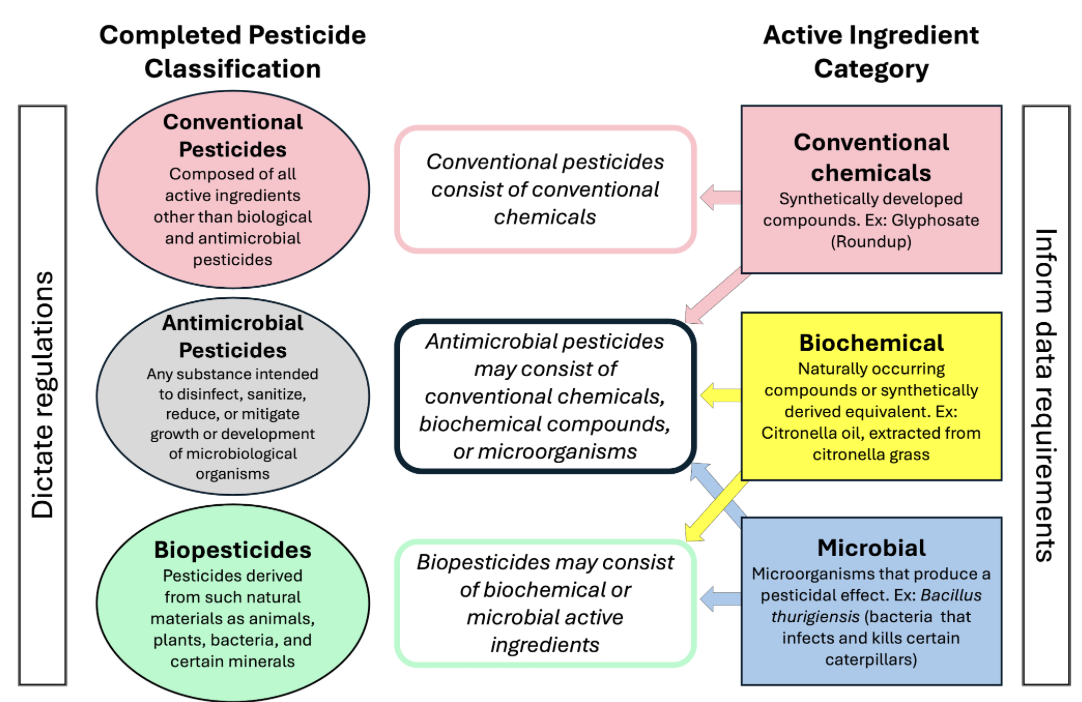
Figure 1. Definitions and relationships between classifications of completed pesticide products and categories of pesticide active ingredients.
Data required for pesticide registration submission must be collected using standardized methods set forth by the EPA or the Organization for Economic Co-operation and Development (OECD). Each required data category has an accompanying series of necessary tests. The various series identify and detail the data required for registration, as well as the test methodology. Additional EPA-accepted standardized test methods are available on the OECD webpage. See the table below for data series and corresponding OECD test methods.
See the table below for EPA data series numbers. Note that tests are reviewed by one of two divisions in the EPA Office of Pesticide Programs: the Registration Division (RD) or the Biopesticides and Pollution Prevention Division (BPPD). Questions regarding tests should be directed to the appropriate division.
| Scientific Data Specifications and Methods 1 Biochemical Pesticides Data Requirements – 40 CFR 158 Subpart U |
|
|---|---|
| EPA Required Data Category and Test Guidelines |
CR – Conditionally Required Explanation (if applicable) |
| Product Efficiacy | |
| Product Performance (Series 810.1000) | |
| Confidential Product Chemistry | |
| Product Identity and Composition (Series 880.1100) | |
| Description of starting materials, production and formulation process (Series 880.1200) | |
| Discussion of formation of Impurities (Series 880.1400) | |
| Certified Limits (Series 830.1750) | |
| Enforcement Analytical Method (Series 830.1800) | |
| Preparing a Confidential Statement of Formula for Biochemical and Microbial Pesticides | |
| Physical & Chemical Properties | |
| Color (Series 830.6302) | |
| Physical State (Series 830.6303) | |
| Odor (Series 830.6304) | |
| Stability to Normal and Elevated Temperatures, Metals, and Metal Ions (Series 830.6313) OECD Test No. 113: Screening Test for Thermal Stability and Stability in Air |
|
| Storage Stability (Series 830.6317) | |
| Corrosion Characteristics (Series 830.6320) | |
| UV/Visible light absorption (Series 830.7050) | |
| Density/Relative Density/Bulk Density (Series 830.7300) OECD Test No. 109: Density of Liquids and Solids |
|
| Water Solubility (Series 830.7840) | |
| Vapor pressure (Series 830.7950) | |
| Ecological Effects | |
| E Aquatic invertebrate acute toxicity, freshwater and marine (if applicable) (Series 850.1010) OECD Test No. 211: Daphnia magna Reproduction Test OECD Test No. 202: Daphnia sp. Acute Immobilisation Test |
|
| E Avian acute oral toxicity (850.2100) | |
| E Avian dietary toxicity (850.2200) | |
| E Fish Acute Toxicity, Freshwater and Marine (if applicable) (Series 850.1075) OECD Test No. 203: Fish, Acute Toxicity Test |
|
| Aquatic field fish/invertebrate testing (Series 850.1950) CR10 | 10. Required if environmental fate characteristics indicate that the estimated environmental concentration of the pesticide in the aquatic environment is >0.01 of any EC50 or LC50 determined in the aquatic nontarget organism testing. |
| Freshwater fish /invertebrate testing (850.1300,1400,1500) CR10 | |
| Marine/Estuarine fish/invertebrate animal testing (850.1025,1035,1045,1055,1350,1400,1500) CR10 | |
| Nontarget Birds, Bees, Plant (All Conditional Requirements) | |
| Terrestrial Plant Toxicity – Seedling Emergence (Series 850.4100) | |
| Terrestrial Plant Toxicity – Vegetative Vigor (Series 850.4150) | |
| Residue Chemistry | |
| Additional test methods- Introduction to OECD Test Guidelines on Pesticide Residues Chemistry – Section 5 Part A | |
| Chemical Identity (Series 860.1100) CR2 | 2. The same chemical identity data are required for biochemical product chemistry data requirements, § 158.2030, with an emphasis on impurities. |
| Nature of residue in plants (Series 860.1300) CR5 | 5. Required unless it is an arthropod pheromone applied at a rate less than or equal to 150 grams active ingredient per acre. |
| Residue Analytic Method (Series 860.1340) CR9 | 9. A residue analytical method suitable for enforcement of tolerances is required whenever a numeric tolerance (including temporary and time-limited tolerances) is proposed. |
| Multiresidue method (Series 860.1360) CR11 | 11. Data are required to determine whether FDA/USDA multiresidue methodology would detect and identify the pesticides and any metabolites. |
| Magnitude of the Reside – Water, Fish, Potable Water, and Irrigated Crops (Series 860.1400) CR12 | 12. Data on fish are required for all pesticides applied directly to water inhabited, or which will be inhabited by fish that may be caught or harvested for human consumption. |
| Reasonable Grounds in Support of Tolerance Petition (Series 860.1560) CR19 | 19. Required when a residue analytical method is required. |
| Mammalian Toxicology Data | |
| E Acute Oral Toxicity-rat (Series 870.1100) OECD Test No. 401: Acute Oral Toxicity |
|
| E Acute Dermal Toxicity (Series 870.1200) OECD Test No. 402: Acute Dermal Toxicity |
|
| E Acute Inhalation Toxicity-rat (Series 870.1300) OECD Test No. 403: Acute Inhalation Toxicity |
|
| E Acute Eye Irritation (Primary eye irritation) – rabbit (Series 870.2400) OECD Test No. 405: Acute Eye Irritation/Corrosion |
|
| E Acute Dermal Irritation (Primary dermal irritation) (Series 870.2500) OECD Test No. 404: Acute Dermal Irritation/Corrosion |
|
| Skin Sensitization (Series 870.2600) OECD Test No. 442B: Skin Sensitization Guideline No. 497: Defined Approaches on Skin Sensitization |
|
| E Hypersensitivity incidents (N/A) | |
| E 90 Day Oral (one species) (Series 870.3100) CR 6 OECD Test No. 410: Repeated Dose Dermal Toxicity: 21/28-day Study |
6. Required for non-food uses that are likely to result in repeated oral exposure to humans. |
| 90 Day Dermal -rat (Series 870.3250) CR7 OECD Test No. 411: Subchronic Dermal Toxicity: 90-day Study |
7. The use pattern is such that the dermal route would be the primary route of exposure. |
| 90 Day Inhalation – Rat (Series 870.3465) CR8 | 8. Required if there is a likelihood of significant levels of repeated inhalation exposure to the pesticide as a gas, vapor, or aerosol. |
| E Prenatal developmental – Rat preferably (Series 870.3700) CR9 | 9. Required if the use of the product under widespread and commonly recognized practice may reasonably be expected to result in significant exposure to female humans (e.g., occupational exposure or repeated application of insect repellents directly to the skin). Tier II data is required on a different test species from Tier I data when developmental effects are observed in the first study and information on species-to-species extrapolation is needed. |
| E Bacterial reverse mutation test (Series 870.5100) CR10 | 10. Required to support nonfood uses if the use is likely to result in significant human exposure |
Additional Data Requirements Details
Additional details on data requirements for Biopesticides can be found in CFR 40 Part 158 Subpart U
The studies required under Part 158 provide the scientific basis for characterizing the potential risks associated with pesticide exposure. There is considerable flexibility available to the EPA in implementing Part 158. For example:
- Additional data may be required (Section 158.75),
- Alternative approaches may be accepted (see OECD Tests in the table above), and
- Studies can be waived (Section 158.45).
Experimental Use Permit
Collection of the required pesticide registration data may require field trials. Unregistered pesticides may be applicable for an Experimental Use Permit (EUP). Although the complete set of registration data may not be available at the time of an EUP request, most studies and resulting data must have been collected before the EPA will grant an EUP. An EUP must also be approved by the state in which the experimental use is to take place. To determine the policy of an individual state, use the external link to the National Pesticide Information Center or the internal link to the US Regulatory Map.
Additional Information
- List of EPA-registered Biopesticide Active Ingredients
- Navigate to the EPA webpage for a list of required data Test Guidelines
- Reviewer requirements. View a list of Standard Data Evaluation Formats used for evaluation by data reviewers.
- BPPD Internal Application Checklists
- Tips for Avoiding Confidential Statement of Formula or Product Chemistry Issues with Biopesticides
- See necessary registration forms, Pesticide Registration Manual: Ch. 20 – Forms and How to Obtain Them
- If your proposed product is substantially similar to another EPA-registered product, you may be able to cite data from existing studies.
- If citing another organization’s data, you must first determine whether you need to pay or get authorization from the data owner to use it. More can be found in the Pesticide Registration Manual: Ch. 10 – Data Compensation Requirements
- Determine the registration fee(s) and review timeframe for your product
- The Pesticide Registration Improvement Act (PRIA, aka PRIA 5) requires the submission of fees associated with EPA assessments of pesticide data.
- Use the PRIA Fee Determination Decision Tree to find the fees and review timeline associated with your product.
- If you are a small business, academic institution, non-profit, or state/federal office, you may qualify for a fee waiver.
- Review Pesticide Registration Manual: Ch. 3 – Additional Considerations for Biopesticide Products
- Schedule a pre-registration meeting with the Office of Pesticide Products Biopesticide and Pollution Prevention Division. See contact information below.
This information was collected from the 40 CFR 158 or EPA’s Test Guidelines for Pesticides and Toxic Substances unless otherwise noted. Please visit the website for more information.
Questions about Biopesticide Registration?
Questions about Biopesticide Registration?
Biochemical Classification Committee
BiochemicalClassification@epa.gov
BPPD Immediate Office
General questions: contact the Biopesticides and Pollution Prevention Department (BPPD) Ombudsman at BPPDQuestions@epa.gov
BPPD Contact List
Click this link to find specific contacts within the EPA’s Biopesticides and Pollution Prevention Department
Regional EPA Office Contacts
Contact your regional EPA office
EPA Contacts
For a full list of contact emails for individuals, offices, and topics, visit the EPA’s Pesticide Contacts Page.
Citation
The information presented on this webpage was collected from 40 CFR 158 and/or EPA’s Test Guidelines for Pesticides and Toxic Substances unless otherwise noted. Please visit the agency’s website for more information.